
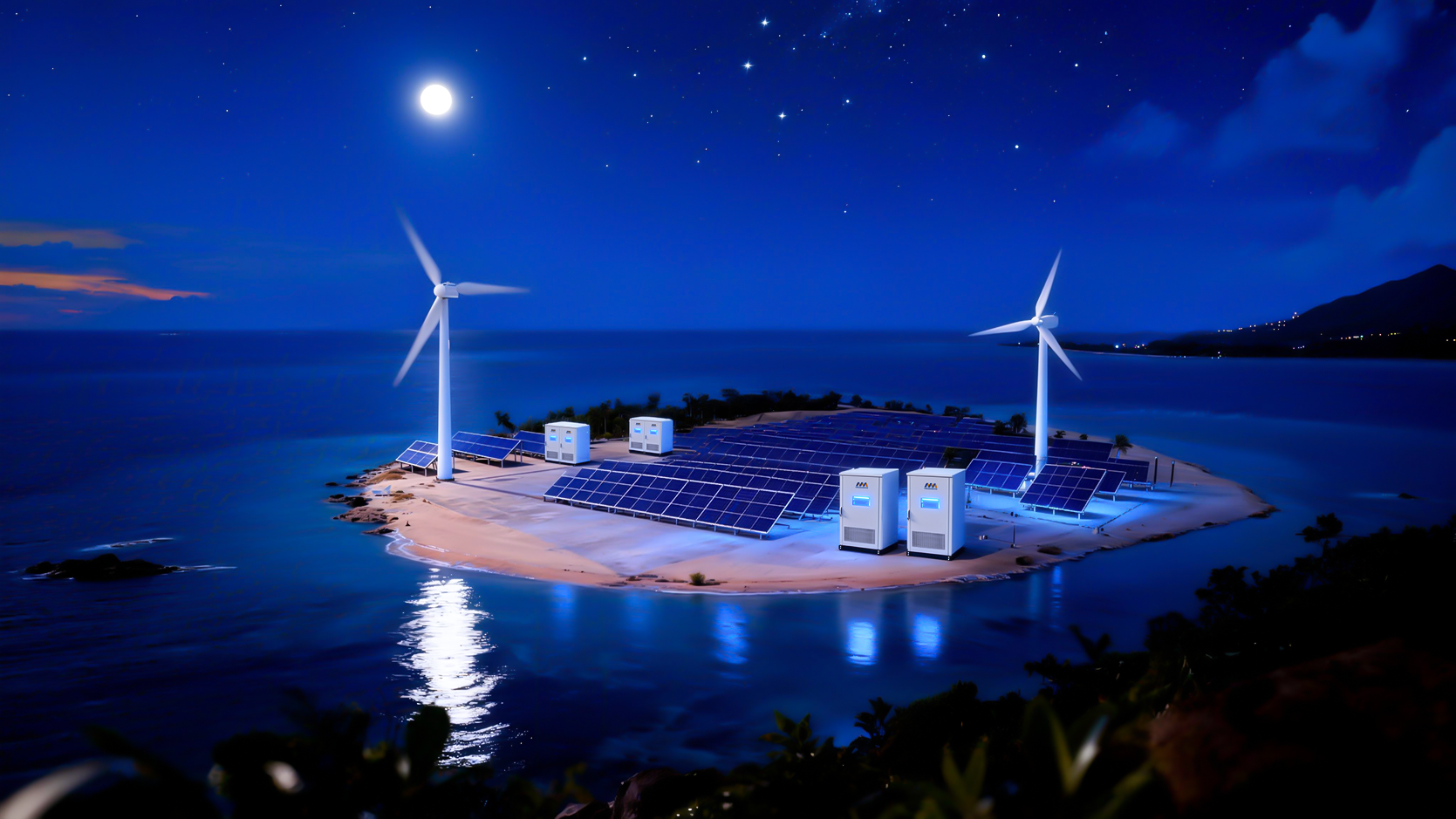
In recent years, industrial and commercial energy storage systems have developed rapidly. In 2024, the global energy storage market was worth $4.5 billion and is projected to grow to $13.2 billion by 2035. Battery energy storage systems employ intelligent control technology to manage the power cycle, which helps businesses operate more efficiently and ensures smooth business operations. So, what should the future technological development trends of battery energy storage systems be? Let's discuss this further.
Consolidation of Lithium Iron Phosphate (LFP) Dominance: Due to its extremely high safety, long cycle life, and cost advantages, LFP has become the absolute mainstream of energy storage cells. The trend is to further optimize its energy density (e.g., through nano-sizing and doping) and low-temperature performance.
Accelerated Industrialization of Sodium-Ion Batteries: As an important supplementary technology, sodium batteries have advantages in resource abundance, low-temperature performance, and cost potential. In the future, they will occupy a place in energy storage scenarios with lower energy density requirements (such as large-scale energy storage and backup power). Lithium-sodium hybrid energy storage systems may become a new form.
New Cathode Materials such as Lithium Iron Manganese (LMP) and Lithium Iron Manganese Phosphate (LMP): Introducing manganese into LFP aims to improve the voltage platform and energy density, representing an important direction for next-generation high-performance, cost-effective cathode materials.
Large-Capacity Cells Become Mainstream: Development is moving from 50Ah and 100Ah to 280Ah, 300Ah+, and even larger capacities. Larger battery cells reduce the number of integrated system components, increase volumetric energy density, and lower BMS management complexity and cost amortization. However, they also place higher demands on consistency and safety.
Process Innovation: Dry electrode processes (such as Maxwell's technology acquired by Tesla) simplify processes, reduce energy consumption, and increase electrode compaction density, representing key manufacturing technologies for next-generation cost reduction and efficiency improvement.
System Integration Level: From "Stacking" to "Deep Integration"
1. System Design Standardization and High Integration
Standardized "Long-Cut" Cells: Standardized long cells, such as those from CATL, facilitate flexible assembly and have become the de facto industry standard.
Cell to Pack" Technology: Eliminating or simplifying module layers, directly integrating cells into the battery pack significantly improves volumetric utilization and energy density while reducing costs. This is a clear integration trend in current energy storage systems.
2. Liquid Cooling Becomes the Mainstream Thermal Management Solution: With increasing system power and energy density, air cooling is no longer sufficient to meet temperature control uniformity requirements. Liquid cooling technology, with its superior heat dissipation efficiency and temperature uniformity, is rapidly replacing air cooling and becoming the standard configuration for medium and large-scale energy storage systems, crucial for extending lifespan and improving safety.
Prevention First, Combining Prevention and Firefighting": The technological focus is shifting from passive fire protection to active protection.
Intrinsically Safe Design: Utilizing materials with better thermal stability (such as LFP), integrating ceramic diaphragms, safety coatings, and pressure sensing devices (CID) within the battery cell.
Early Warning and Intervention: Achieving minute-level or even hour-level early warning of thermal runaway through aerosol and combustible gas (such as VOC, CO, hydrogen) sensors and temperature/voltage AI algorithms.
High-Efficiency Fire Extinguishing and Isolation: Developing high-efficiency, insulating fire extinguishing media such as perfluorohexanone and fine water mist, and designing pack-level or cell-level rapid fire isolation channels to prevent heat spread.
Intelligentization and Digitalization: From "Energy Storage System" to "Smart Energy Unit"
Advanced BMS and Digital Twin
Cloud-Edge-Device Collaborative BMS: The local BMS handles basic protection and control, while the cloud-based BMS/big data platform analyzes massive amounts of data (voltage, temperature, internal resistance, etc.) to achieve accurate state estimation, lifespan prediction, fault diagnosis, and distribute optimization strategies.
Digital Twin Technology: Constructs a virtual image of the energy storage system, simulating state, predicting performance, and optimizing operating strategies in virtual space to achieve preventative maintenance and maximize asset value.
AI-Powered Full Lifecycle Management
AI-Optimized Operating Strategies: Based on information such as electricity prices, load forecasts, and weather, AI algorithms formulate optimal charging and discharging strategies to maximize revenue or reduce electricity costs.
AI-Enhanced Safety and Lifespan: Through machine learning models, early cell degradation characteristics are more accurately identified, thermal runaway risks are predicted, and charging and discharging parameters are dynamically adjusted to extend lifespan.
Application Scenarios and Business Models Driving Technological Differentiation
Balancing economy and flexibility. Emphasizing safety and reliability, the structure is modular, plug-and-play, and quick to install, and deeply integrated with photovoltaics, charging piles, and load management.
Future new energy storage systems will be deeply integrated with power electronics, digitalization, AI, and IoT technologies, evolving from simple "energy storage and dispensing devices" into "smart grid nodes" and "tradable assets" with sensing, decision-making, and execution capabilities. The ultimate goal is to achieve "lower costs, higher security, longer lifespan, and smarter applications" throughout the entire lifecycle, thus becoming a cornerstone technology for building new power systems.
.png "English")
.png "中文")
.png "Arab")
.png "Spain")
.png "Portugal")


