

Adding batteries to an existing PV array is a frequent requirement for utilities, integrators, and EPCs who manage aging or expanding solar installations. For retrofit scenarios, AC-coupling — where a storage inverter connects on the AC side of an existing grid-tied PV inverter — is often the fastest, lowest-impact route to add storage capability without ripping out perfectly good PV assets.
This article explains how AC-coupling works in practice, why a 240v hybrid inverter is often the best hardware choice for retrofit projects, and what procurement and installation teams should watch for when designing a safe, code-compliant solution.
In an AC-coupled retrofit, the battery and its hybrid inverter sit downstream of the PV string inverters:
PV → original inverter → main distribution panel → hybrid inverter → battery
The hybrid inverter forms a local microgrid during outages and manages battery charge/discharge while the grid is present. When multiple vendors are involved and direct digital communication is absent, the industry-standard method for coordinating PV output and battery charging is to use frequency-based signals (often called “frequency shifting” or Freq/Watt control). The battery inverter slightly raises or lowers its local AC frequency to cue grid-tied PV inverters to reduce or increase power output, thereby preventing over-charging and enabling controlled backup operation. This approach is widely supported by manufacturers and is consistent with interoperability requirements within modern interconnection standards.
For many retrofit targets — single-phase residential panels, light commercial split-phase systems, or US/Latin America markets that use 220–240 VAC leg-to-neutral voltages — a 240v hybrid inverter provides the right electrical interface without transformer reconfiguration. A purpose-built 240v hybrid device delivers:
Native compatibility with existing 240 VAC distribution and split-phase loads;
Integrated islanding and black-start capabilities so the site can support critical loads during outages;
Configurable Grid Support functions (Freq/Watt, Volt/VAR) that allow safe coordination with legacy PV inverters; and
Simplified wiring and reduced balance-of-system complexity compared with adding an entirely new DC-coupled architecture.
Modern interconnection and performance requirements — exemplified by IEEE 1547 and associated test practices — explicitly address how distributed energy resources should behave during abnormal conditions and how they may support grid needs. In practice, specifying inverters that implement IEEE 1547-compliant functions (ride-through, Volt/VAR, Freq/Watt) reduces project risk, simplifies permissions with utilities, and creates predictable behavior during islanding and restoration scenarios. Procurement teams should include compliance checks and mode-setting capabilities in RFPs for retrofit works.
When evaluating potential 240v hybrid inverters for retrofit projects, require vendors to provide the following clearly in the spec sheet:
Nominal AC connection options and supported L-N voltages (e.g., 220/230/240 VAC) and grid type.
Grid-support function list — Freq/Watt, Volt/VAR, trip/ride-through settings, adjustable deadbands.
Battery voltage window, max charge/discharge power, and parallel/scalable configurations.
Communication interfaces (BMS protocols, EMS/SCADA integration) and remote monitoring/firmware update capability.
Certifications (EN/IEC/UL/regionals) to match permitting needs on target grids.
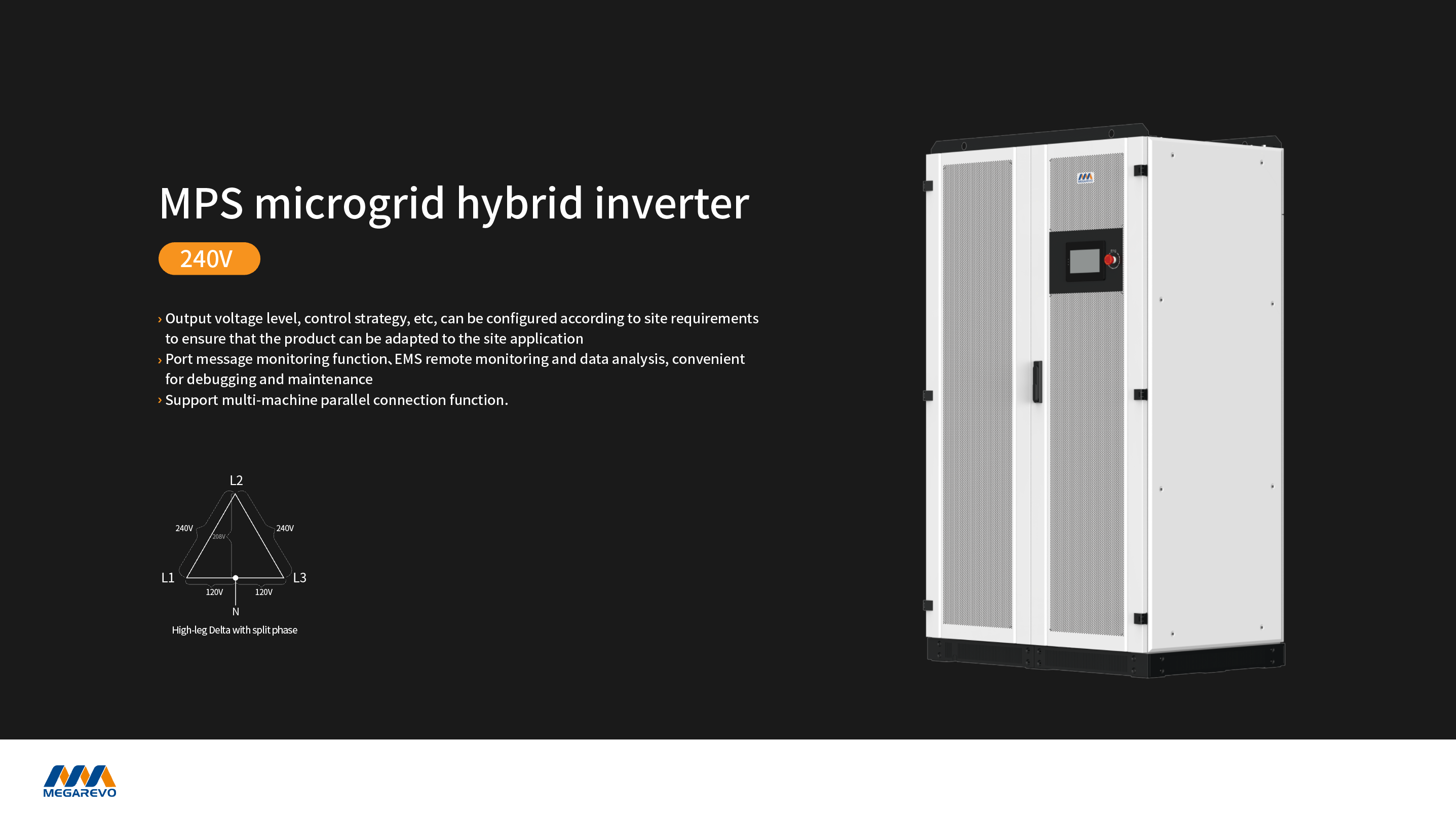
To address the specific demands of AC-coupled retrofit projects where preservation of existing PV assets and operational reliability are paramount, Megarevo’s MPS microgrid series (240V) provides a purpose-built solution that aligns with the electrical and control requirements of such upgrades.
Our MPS series supports a range of High-leg delta split-phase 240 VAC configurations, offering models from roughly 30 kW through 250 kW to accommodate residential, light commercial, and larger rooftop retrofit scopes. Its hybrid architecture integrates PV MPPT control, energy storage conversion, and automatic on/off-grid switching into a single unit, reducing system complexity and installation time.[TW1]
Specifically, for retrofit use-cases:
Electrical interface compatibility: The unit’s native 240 V split-phase output aligns with common North American and other 220–240 VAC distribution systems without requiring transformer reconfiguration.
Flexible PV & battery support: The MPS series accommodates wide PV and battery voltage ranges (e.g., MPPT range 250–850 V and configurable battery voltage windows) and supports multiple MPPT strings to balance PV production and energy storage input.
Scalability: Multiple MPPTs and model sizes allow procurement teams to right-size systems for specific retrofit capacities, while parallel operation supports larger energy storage aggregations.
Integrated monitoring & control: Local LCD touch-screen interface plus remote EMS/RS485/TCP-IP/CAN communications facilitate commissioning, performance analysis, and remote supervision—important for mixed-vendor environments.
Robust environmental and protection design: Air-cooled construction with IP20 rating, broad operating temperature range, and standard protection functions support stable performance across diverse installation conditions.
By combining electrical compatibility with site-adaptable controls and system monitoring, the Megarevo MPS 240 V hybrid inverter series delivers a practical hardware choice for AC-coupled retrofit projects where integration with existing PV assets and grid interaction requirements are central concerns.
For utilities, EPCs, and system integrators upgrading existing PV assets, AC-coupled retrofits offer a practical, low-disruption path to adding energy storage. By connecting the battery inverter on the AC side, teams can preserve proven PV infrastructure while minimizing downtime and simplifying balance-of-system complexity.
Within this framework, Megarevo’s MPS 240 V Hybrid Inverter stands out as a retrofit-ready solution. Its native 240 VAC split-phase compatibility, integrated islanding and black-start capabilities, and support for standardized grid functions like Freq/Watt and Volt/VAR enable predictable, code-compliant operation across normal, abnormal, and islanded conditions. Flexible MPPT and battery voltage ranges, along with robust communication and monitoring features, make it adaptable to diverse residential and light commercial retrofit scenarios.
By choosing a platform like Megarevo’s MPS series, project teams can extend the life and value of existing PV arrays, simplify installation and commissioning, and create resilient energy storage systems that are prepared for both current needs and future grid evolution.
.png "English")
.png "中文")
.png "Arab")
.png "Spain")
.png "Portugal")


