
The 1500V PCS (Power Conversion System) has become the preferred choice for large-scale microgrids primarily because it achieves system-level cost reduction and efficiency improvement through "high voltage," perfectly meeting the comprehensive requirements of large-scale projects for economy, efficiency, and reliability.
We can understand this from the following key perspectives:
This is the most direct and important reason. According to the physical principle P = UI (Power = Voltage × Current), for the same output power (P), increasing the voltage (U) can significantly reduce the current (I).
• Reduced Cable and Switching Costs: Reduced current means that thinner cables, smaller-sized circuit breakers, contactors, and other electrical equipment can be used. This directly saves on material and installation costs.
• Reduced Number of Parallel Devices: For example, to achieve 1MW of power, a traditional 1000V system might require two 500kW PCS in parallel. With a 1500V system, perhaps only one 1MW PCS or fewer parallel units are needed. This reduces the number of devices, floor space, and complex parallel control logic.
• Saves on construction and maintenance costs: Fewer devices and thinner cables mean simpler system design, faster installation, and fewer maintenance points later on.
Reduce Losses: With reduced current, according to Joule's law Q = I²R, and assuming a constant line resistance (R), line losses (Q) are proportional to the square of the current. Therefore, halving the current reduces line losses to one-quarter of their original value. This significantly increases power generation and economic benefits over the long lifespan of a microgrid.
• Improve PCS Efficiency: 1500V platforms typically employ more advanced power semiconductor devices (such as SiC) and topologies, resulting in higher conversion efficiencies compared to traditional 1000V platforms, further reducing losses in the energy conversion process.
Large-scale microgrids are typically conjunction with large-scale photovoltaic (PV) power plants. In recent years, the PV industry has fully transitioned from 1000V systems to 1500V systems (due to higher open-circuit voltage of PV strings). Using a 1500V PCS (Power Generation System) allows for:
• DC-side voltage matching: PV arrays and energy storage batteries can be directly matched at higher DC voltages without the need for additional boost converters or complex voltage adaptations, resulting in a simpler and more efficient system architecture.
• Unified DC bus: Facilitates the construction of integrated PV-energy storage DC-coupled systems, reducing unnecessary DC-AC-DC conversion steps and further improving overall efficiency.
As energy storage power plants expand to the megawatt-hour (MWh) and gigawatt-hour (GWh) levels, system scale is increasing dramatically.
• Increased Energy Density: 1500V systems can deploy more battery capacity and power within the same footprint, improving the overall energy density and land utilization of the power plant.
• Simplified System Structure: The increased voltage level allows for the achievement of the required total capacity with fewer battery clusters connected in parallel, reducing circulating current problems and management difficulties caused by inconsistencies between battery clusters.
Early 1500V technology was mainly used in large-scale ground-mounted photovoltaic power plants, and its reliability has been fully verified. Today, the entire supply chain—from photovoltaic modules, combiner boxes, DC switches to PCS and battery systems—is mature enough to support the 1500V platform, forming a complete ecosystem that makes procurement and maintenance very convenient.
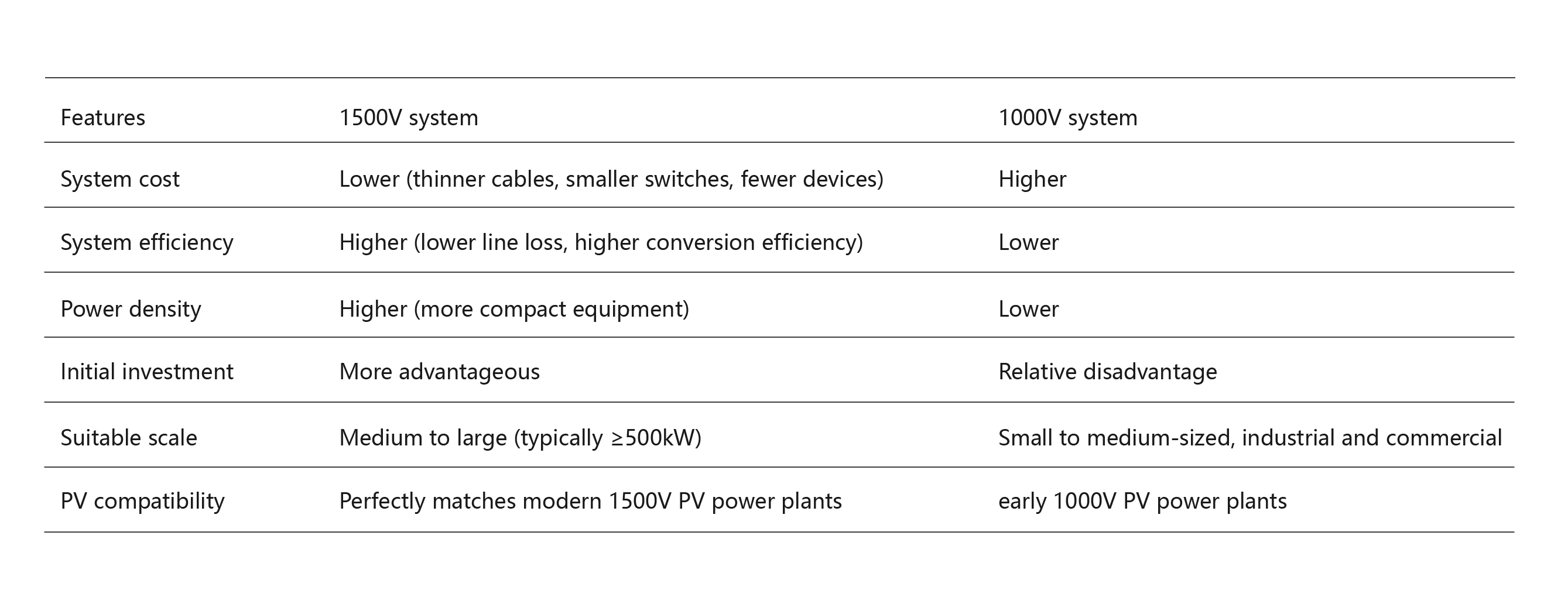
Conclusion:For large-scale microgrids, the core objective is to maximize economic benefits throughout their entire lifecycle while ensuring safety and reliability. The 1500V PCS solution, through its high-voltage approach, achieves cost savings and efficiency improvements across the entire chain, from equipment procurement and installation to long-term operation, and aligns with mainstream photovoltaic and energy storage technology trends. Therefore, it is no longer an "optional" solution, but rather the standard configuration and preferred solution in the current design of large-scale microgrids and energy storage power stations.
Of course, for small-scale commercial, industrial, or residential microgrids, 1000V or lower voltage systems still have market potential due to their flexibility and cost advantages. Ultimately, the choice of technology depends on the specific project scale, budget, and application scenario.
.png "English")
.png "中文")
.png "Arab")
.png "Spain")
.png "Portugal")


